
When I was little, I discovered the great Sherlock Holmes through an animated series where the characters were dogs of various breeds. I instantly fell in love with that canine detective who smoked a pipe and donned the classic deerstalker cap. As the years passed, I rediscovered him through books, in a special edition whose tartan covers in varying hues I still remember fondly.
Unlike Hercule Poirot, I came across Sherlock by pure chance. Poirot, on the other hand, I discovered thanks to my mother, a tireless reader who treasured books on history, classic and contemporary fiction, theatre, poetry, essays, and much more.
Well then, today I am going to introduce you to some of the greatest detectives in history. And I say some because later on I will write another article dedicated to other investigators—perhaps less widely known, but no less important.
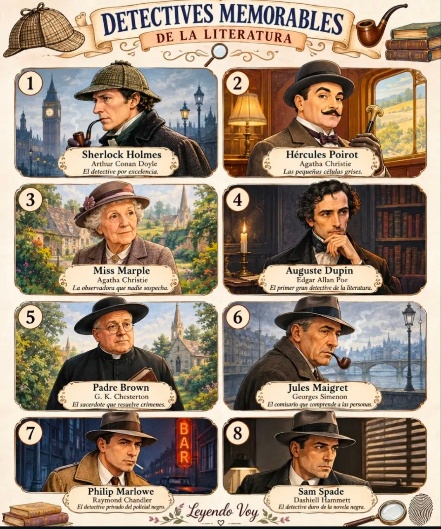
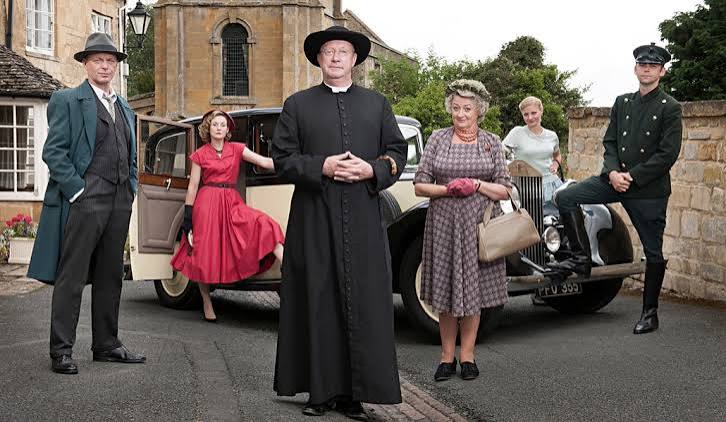
Father Brown
Father Brown is a fictional character created by the English novelist G. K. Chesterton (1874–1936). He is the protagonist of around fifty short stories later compiled into five books.
- Real inspiration: In Father John O’Connor (1870–1952), a Bradford parish priest in Yorkshire who was instrumental in Chesterton’s conversion to Catholicism in 1922. Father O’Connor recorded this connection in his 1937 book, Father Brown on Chesterton.
Father Brown is a Catholic priest of unassuming appearance whose sharp psychological acumen makes him a formidable detective. Short and stocky, “formerly of Cobhole in Essex, and now working in London,” he is accompanied by an enormous umbrella and typically solves the most baffling, atrocious, and inexplicable crimes through his deep understanding of human nature rather than purely deductive logic.
He made his debut in the famous story The Blue Cross and continued across five volumes of short stories. He is often assisted by the reformed criminal Flambeau. Unlike his more famous contemporary, Sherlock Holmes, Father Brown’s methods tend to be intuitive rather than deductive.
Publications
He starred in approximately 50 short stories written between 1911 and 1935.
Film and Television Adaptations
Twenty years later came the first major television adaptation. In 1974, ITV produced a thirteen-episode series starring Kenneth More. This version is especially cherished by Chesterton admirers for its remarkable fidelity to the original stories, capturing not only the mystery plots but also the intellectual atmosphere and subtle humor characteristic of the author’s writing.
The most popular adaptation for modern audiences premiered in 2013 with the British BBC One series Father Brown, starring Mark Williams. While drawing upon Chesterton’s characters and storylines, it relocates the action to rural England in the 1950s and crafts numerous original plots. Its tone aligns closely with cozy crime, a subgenre characterized by gentle mysteries, nostalgic settings, and minimal graphic violence. The series gained immense popularity and has aired for over a decade.
Creative Spins and Spin-offs
From this adaptation arose Sister Boniface Mysteries, launched in 2022. The series centers on Sister Boniface, a character introduced in the BBC production, expanding Father Brown’s televised universe without directly adapting Chesterton’s original tales.
Sherlock Holmes
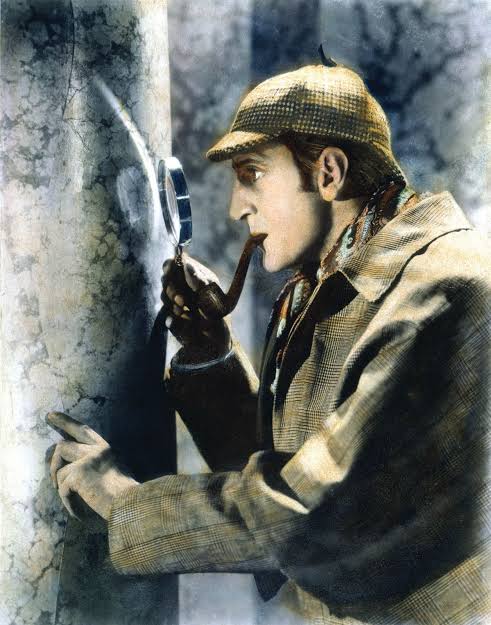
Sherlock Holmes was created by Scottish physician and writer Arthur Conan Doyle, making his first appearance in 1887. Like G. K. Chesterton’s Father Brown, he stands among the most iconic detectives in world literature, yet operates with an entirely different philosophy and approach to crime-solving.
Key Facts About Sherlock Holmes
- First appearance: In the novel A Study in Scarlet (1887).
- Real-life inspiration: Conan Doyle modeled him after Dr. Joseph Bell, a university professor whose ability to diagnose conditions and deduce patients’ personal histories at a glance was legendary.
- Legendary address: 221B Baker Street, London.
Publications
He starred in 4 novels and 56 short stories collected in several books.
Screen Adaptations of Sherlock Holmes
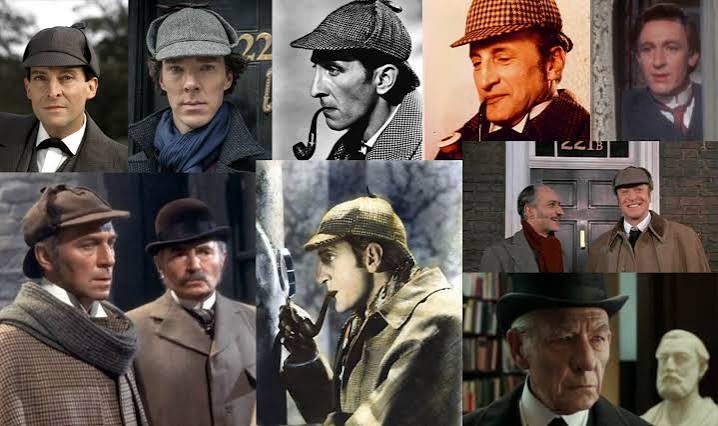
They have been so extensive that Sherlock Holmes holds the Guinness World Record for the most portrayed human literary character on screen. Over more than a century, his portrayal has evolved from the classic Victorian depiction to action-packed, comedic, and even science fiction reimaginings.
Classic Portrayals
These versions established the character’s enduring popular iconography (such as the deerstalker cap and calabash pipe—elements that do not strictly originate from Conan Doyle’s original prose):
- The Basil Rathbone Era (1939–1946): Rathbone starred in 14 feature films. The Hound of the Baskervilles (1939) was the first to faithfully recreate the original Victorian setting.
- Hammer’s Sherlock (1959): Peter Cushing embodied the detective in a celebrated, atmospheric Gothic rendition of The Hound of the Baskervilles, produced by the legendary Hammer horror studios.
- The Pinnacle of Fidelity: On television, the British series The Adventures of Sherlock Holmes (1984–1994) cemented Jeremy Brett as the definitive Holmes for literary purists, thanks to his impeccable physical and psychological fidelity to the canon.
The Modern Action Hero
Twenty-first-century cinema transformed the analytical sleuth into a dynamic blockbuster powerhouse:
- Guy Ritchie’s Reinterpretation (2009–2011): Starring Robert Downey Jr. and Jude Law, Sherlock Holmes and its sequel reimagined him as a steampunk action hero, emphasizing his physical martial prowess alongside lightning-fast visual deduction.
Contemporary Adaptations
- Sherlock (BBC, 2010–2017): This critically acclaimed British series starring Benedict Cumberbatch and Martin Freeman transported the detective into 21st-century London. Replacing telegrams with text messages and horse-drawn hansom cabs with black cabs, it achieved massive global acclaim.
- Elementary (CBS, 2012–2019): An American procedural set in contemporary New York, starring Jonny Lee Miller alongside Lucy Liu as a female Joan Watson.
Creative Variations and Alternate Takes
The Baker Street universe has also fostered clever narrative experiments and homages:
- Young Sherlock Holmes (1985): An adventure film executive produced by Steven Spielberg that imagines Sherlock and Watson meeting as boarding school classmates during their teenage years.
- Mr. Holmes (2015): A poignant drama where Ian McKellen portrays a 93-year-old retired Sherlock in Sussex, grappling with memory loss while striving to solve his final unsolved case.
- The Expanded Enola Holmes Universe (2020–2026): Netflix films starring Millie Bobby Brown as the detective’s spirited younger sister, featuring Henry Cavill as a supporting, noticeably more empathetic Sherlock.
Related Articles
- Sherlock Holmes’s Alter Ego: Joseph Bell
- Curiosities of Sir Arthur Conan Doyle and His Famed Yet Despised Sherlock Holmes
Miss Marple
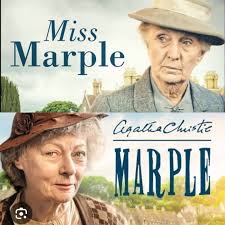
Miss Marple (whose full name is Jane Marple) is one of the most beloved detectives in mystery fiction, created by British author Agatha Christie. Unlike many of her contemporaries, she is not a professional sleuth, but an elderly spinster.
She resides in the quaint, fictional English village of St. Mary Mead. Despite her unassuming appearance as a sweet grandmother tending her garden and knitting wool, she possesses extraordinary mental sharpness and an uncanny insight into human nature. This enables her to crack the most complex murders by drawing parallels to minor village occurrences.
- First appearance: She debuted in December 1927 in the short story The Tuesday Night Club. Her first full-length novel was The Murder at the Vicarage in 1930.
- Literary career: She appeared in 12 novels and 20 short stories across multiple anthologies. Her final published case was Sleeping Murder in 1976.
- Method of investigation: She avoids magnifying glasses and fingerprint hunting; her success stems from psychological observation and her steadfast belief that “human nature is much the same everywhere.”
Film and Television Adaptations
She has been portrayed on screen by acclaimed actresses such as Joan Hickson in the revered BBC series Miss Marple (1984–1992), widely regarded as the definitive embodiment of the character. Later, Geraldine McEwan took up the mantle in Agatha Christie’s Marple (2004–2009), presenting a lively, inquisitive interpretation, while Julia McKenzie followed from 2009 to 2013 with a calmer, observant presence.
Several novels have also been adapted for the silver screen, notably Murder, She Said (1961), starring Margaret Rutherford, whose idiosyncratic portrayal—while divergent from Christie’s written descriptions—gained immense popularity and helped introduce the character to millions worldwide.
Although Agatha Christie harbored the greatest personal affection and affinity for Miss Marple among all her creations, the character never achieved the same commercial reach as her iconic Belgian sleuth, Hercule Poirot.
Related Articles
Philip Marlowe
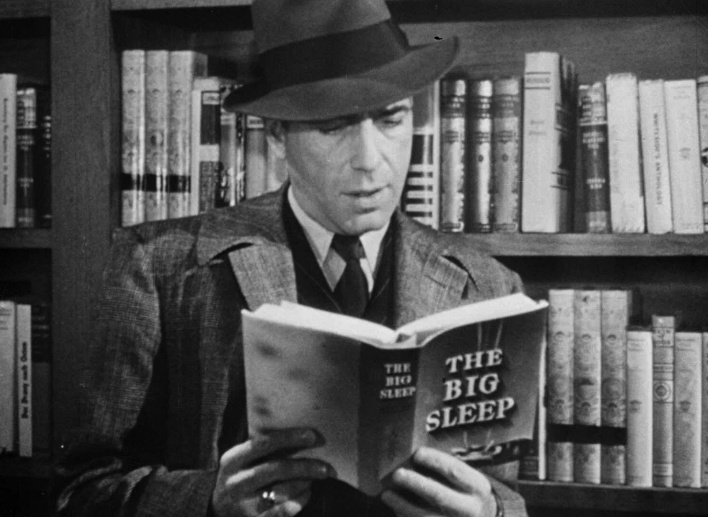
Philip Marlowe is the iconic private eye created by American author Raymond Chandler. He embodies the quintessential hard-boiled detective archetype: cynical, solitary, yet governed by an unwavering moral compass and a strict personal code of honor within a thoroughly corrupt society.
He is a contemplative, philosophical soul—an avid chess player who solves problems alone in his office, and a lover of poetry beneath his tough, hard-drinking exterior.
Marlowe lives and works in Los Angeles, California, traversing and chronicling the city with a melancholic, observant eye. He never pursues violence for pleasure nor can he be bribed. He operates for a modest daily fee and remains fiercely loyal to his clients, even when it endangers his life.
Publications
Philip Marlowe headlines seven novels written by Raymond Chandler between 1939 and 1958, cornerstones of American noir fiction. To these is added Poodle Springs (1989), left unfinished by Chandler and completed by Robert B. Parker.
Following Chandler’s passing, Marlowe’s legacy continued in estate-authorized novels, including Poodle Springs (1989) and Perchance to Dream (1991) by Robert B. Parker; The Black-Eyed Blonde (2014) by John Banville; Only to Sleep (2018) by Lawrence Osborne; alongside recent reinterpretations by Joe Ide and Denise Mina, ensuring the hard-boiled icon remains vibrantly alive.
Film Adaptations
The private eye has been played by Hollywood greats:
- Humphrey Bogart: In Howard Hawks’ legendary adaptation of The Big Sleep (1946), widely hailed as the definitive cinematic incarnation.
- Robert Mitchum: Portrayed Marlowe twice (Farewell, My Lovely in 1975 and a remake of The Big Sleep in 1978).
- Elliott Gould: In Robert Altman’s deconstructive 1970s classic The Long Goodbye (1973).
- Liam Neeson: In Marlowe (2022), based on John Banville’s authorized novel.
Related Articles
- Differences Between Detective Fiction, Thriller, and Cozy Crime
- Differences Between Police Procedural and Noir Fiction
Hercule Poirot
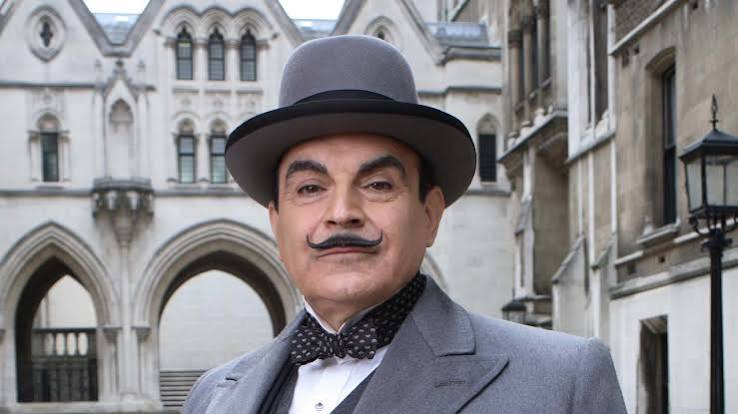
Hercule Poirot is the celebrated Belgian private detective created by British author Agatha Christie. He is among the most famous sleuths in all detective fiction, appearing in 33 novels and over 50 short stories published between 1920 and 1975.
Key Details of Hercule Poirot
- A gentleman of compact stature with an egg-shaped head and a meticulously waxed military mustache.
- He disdains crude physical clues (such as footprints or cigarette ash), relying wholly upon his “little grey cells” and human psychology.
- Fastidious and eccentric, he possesses an obsessive dedication to order, symmetry, neatness, and method, along with unshakeable pride in his intellect.
- He loves chocolate, tisanes, and fine Belgian cuisine.
- He consistently reminds everyone that he is Belgian, not French.
Publications
His first case was The Mysterious Affair at Styles (1920). He subsequently featured in 33 novels, over 50 short stories, and several stage adaptations. Curtain (1975) was the final novel in which Christie brought the Belgian sleuth’s illustrious career to a definitive close.
Film and Television Adaptations
Poirot has been portrayed by distinguished actors across stage and screen:
- David Suchet: Starred in the landmark British series Agatha Christie’s Poirot (1989–2013), acclaimed as the definitive and most faithful portrayal.
- Albert Finney: Earned an Academy Award nomination for Murder on the Orient Express (1974).
- Peter Ustinov: Brought a more robust, witty presence to the role in films like Death on the Nile (1978) and Evil Under the Sun (1982).
- Kenneth Branagh: Directed and starred in the recent cinematic adaptations, including Murder on the Orient Express (2017), Death on the Nile (2022), and A Haunting in Venice (2023).


