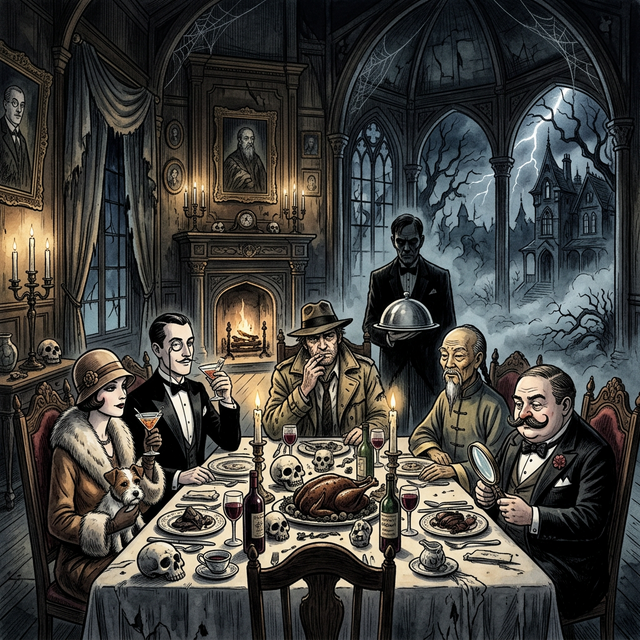
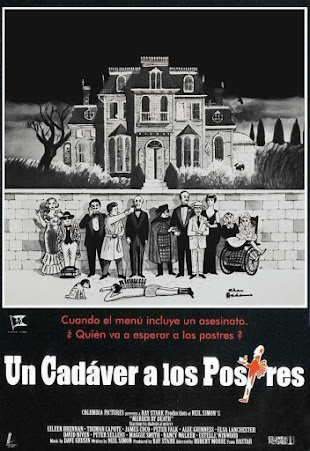
I vividly remember the first time I saw Murder by Death. I was an adolescent, and it gripped me from the opening minutes. I was fascinated by the setting, which felt more like an elaborate theatrical stage than a traditional film set. Even then—before I knew much about cinema—I understood that these detectives were ironic reflections of legendary figures from literature and film.
Neil Simon clearly delighted in skewering the red herrings, impossible twists, and “rabbit-out-of-a-hat” solutions that so often populated the final chapters of classic mystery novels. He turned the genre into a conscious game, a gentle mockery of stories that try to outsmart the reader at any cost.
Humor permeates every frame of the plot: a literal fog machine, an artificial storm generator, a blind butler, a deaf-mute cook who cannot read, and an eccentric host who summons the world’s most prestigious detectives to a dinner… that he himself fails to attend. The film advances through absurd situations and unexpected turns, as each detective presents their own theory with a confidence as misplaced as it is comical. Simon effectively pokes fun at the outsized egos of these legendary investigators and the excessive solemnity with which they usually resolve their cases.
Synopsis
Five celebrated detectives, each accompanied by a trusted assistant or companion, receive a mysterious invitation to a “dinner and a murder” at the mansion of the enigmatic billionaire Lionel Twain. Upon arrival, they are greeted by a seemingly blind butler and a deaf-mute cook. After a journey marked by obstacles and a dinner plagued by incidents, Twain appears to announce that a murder will be committed at midnight. Furthermore, he declares that whoever solves the case will win a million dollars.
The detectives attempt to stay together to prevent the crime, but they soon discover the mansion is a labyrinth of traps, hidden rooms, and deceptions. At the stroke of midnight, they find Twain himself dead, stabbed to death. Each detective quickly formulates their own theory, revealing that they all had motives to wish him dead.
Throughout the night, each pair survives an assassination attempt in their respective rooms. It is then revealed that the butler was neither dead nor blind; he is, in fact, Twain in disguise. He confesses to having orchestrated the entire evening as revenge, considering the detectives to be frauds who deceive their readers by withholding clues in their novels. None truly solve the case, and they are all expelled without a prize.
Finally, as the guests depart, the ultimate truth is revealed: Yetta, the cook (who was not deaf-mute after all), is the true mastermind behind the entire plot.
Release
The film premiered in U.S. theaters on June 23, 1976. Its international release eventually reached countries such as Poland, Hungary, Japan, Italy (where it participated in the Venice Film Festival), and Spain.
Cast
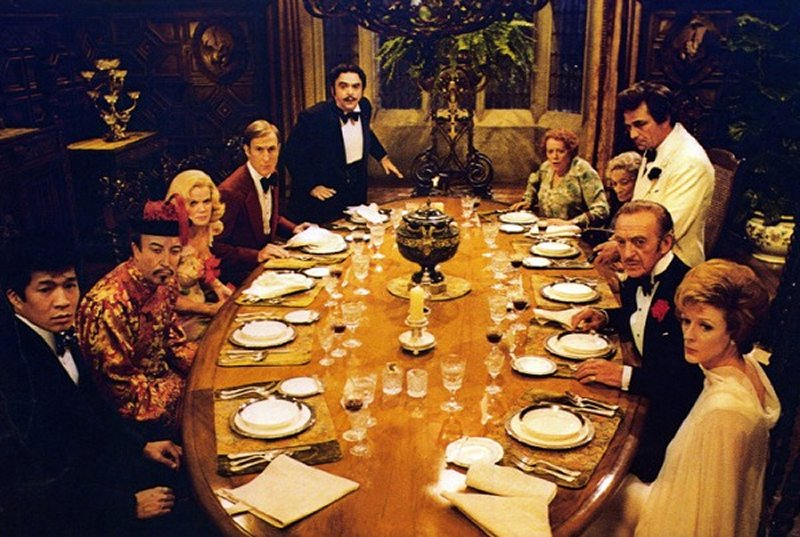
- Peter Sellers portrays the iconic Chinese detective Sidney Wang, a parody of Charlie Chan. He wears elaborate traditional attire, speaks with a heavy accent, and habitually uses (and misuses) aphorisms. He is accompanied by his adopted son, Willie Wang (Richard Narita).
- David Niven and Maggie Smith are Dick and Dora Charleston, an elegant, cosmopolitan couple based on Nick and Nora Charles. They are rarely seen without a drink in hand and are accompanied by their dog, Myron.
- James Coco plays the Belgian detective Milo Perrier, a clear parody of Hercule Poirot. Gluttonous and sharp-tongued, he travels with his secretary, Marcel Cassette (James Cromwell).
- Peter Falk embodies Sam Diamond, a riff on Sam Spade (the detective from The Maltese Falcon). Gruff, rude, and accompanied by his secretary Tess Skeffington (Eileen Brennan).
- Elsa Lanchester is Jessica Marbles, a reflection of Agatha Christie’s Miss Marple. A woman of resolute character, she travels with her elderly nurse, Miss Withers (Estelle Winwood).
- Truman Capote brings the eccentric host Lionel Twain to life—a millionaire obsessed with electronics and a gloomy mansion full of tricks.
- Alec Guinness is the butler Jamesir Bensonmum. Blind, dry-witted, and central to many of the film’s wordplays and comedic situations.
Production
Playwright Neil Simon aimed to write a piece that mocked the conventions of mystery novels. He drew inspiration from the great literary detectives and likely from Agatha Christie’s And Then There Were None. A total of thirteen actors and actresses appear, with the cook particularly standing out; despite not saying a word, she becomes one of the most charismatic characters thanks to her incredible expressiveness.
Film Curiosities
With this premise, Simon and director Robert Moore reproduced the characteristic situations of the genre while turning them on their heads:
- Costume and Music: Ann Roth handled the costumes, and Dave Grusin composed the soundtrack. The decoration of the rooms is inspired by the detectives’ various countries of origin.
- Opening Credits: The caricatures in the credits and on the poster were created by Charles Addams, the creator of The Addams Family. The actors are presented “In diabolical order.”
- Reception: Today, it is considered a cult classic. It holds a 7.4/10 on IMDb and a 7.2/10 on FilmAffinity. It is especially valued for its absurd humor and the standout performances of Sellers, Guinness, and Niven.
- Deleted Scene: There is an additional scene (broadcast only on television) featuring Sherlock Holmes and Dr. Watson, who arrive late at the mansion after getting lost.