“All that we see or seem is but a dream within a dream.”
His work has been cataloged as both sublime and horrendous; an author who found no success in life.
“My life has been whim—impulse—passion—a longing for solitude—a scorn of all things of this world—an honest desire for the future.”
An American columnist and poet, the initiator of the mystery and detective genres, Poe succeeded in renewing European writing with his tales of terror and opening the door to the proto-science of science fiction. At the time, his contemporaries were unaware of the profound degree to which he would influence society across all fields: literature, comics, cinematography, painting, and television.
Family Data
Born in 1809 in Boston, where his brother had already been born in 1807 and where his younger sister would be born in 1810. The son of actors, his father abandoned him when he was only a year old, and his mother died when he was just two. It was a presage of a lifelong search for human warmth—a warmth that was scarce from his birth and which he would seek until the very end.
His name was taken from a character in William Shakespeare’s King Lear.
He was taken in by a Victorian couple, Frances and John Allan, of Richmond, Virginia. He never truly understood John Allan; however, his foster mother (whom he regarded as his real mother), was the one who provided him with an education in Boston, Richmond, London, and Scotland. Without her, Poe would not have become the cosmopolitan figure he was. Foster mother and son shared a deep melancholy.
In 1812, Poe was baptized, and in 1815 the family moved to Scotland, where he was schooled in Irvine before heading to London in 1816 to study in Chelsea. When his foster father, John, failed to achieve the desired success in his business, they returned to North America.
Regarded as a true Southern gentleman, he received a Southern Victorian gentleman’s education in Richmond (at the English Classical School and other institutions). There he learned from the classics, though he also paid close attention to the stories he heard from sailors, as well as those from Black slaves, his nanny, and a multitude of legends.
In 1823, he fell in love with the mother of a classmate, dedicating his first and famous poem “To Helen” to her—his first great love (she passed away at the age of 30).
Between 1824 and 1825—a time when there was no peace between him and his father—the latter wrote in a letter: “Of what are we guilty? It is something I have never understood; that I have borne his conduct for so long is what surprises me most… this boy hasn’t a spark of affection for us, for me, nor gratitude for all my care and for all my kindness to him.” For this reason, all his love was reserved for his mother, Frances.
In 1826, he entered the University of Virginia to study languages.
The Army
From those dates, gambling debts would haunt him, and alcohol provided a certain degree of peace until it took control of his life. Eventually abandoning the University, he found himself unable to live independently, leading him to join the Army. Thus, in 1827, he enlisted as a private under the name Edgar A. Perry, lying about his age to gain entry. He was stationed at Fort Independence, and that same year he published his first book of poetry—a 40-page volume titled Tamerlane and Other Poems (only 50 copies were printed). After serving two years and reaching the rank of Sergeant Major in Artillery, his time there became overwhelming.
His foster mother, Frances, passed away in August 1829. Poe arrived too late for the final farewell to the woman who had been his mother; his foster father had notified him too late. He was found weeping and screaming at the foot of his mother’s grave twenty-four hours after her funeral.
John Allan helped his foster son obtain a discharge from the Army, but in exchange, he forced him to enlist in the West Point Academy to study for an officer’s commission. Around that time, Poe published his second book of poems. He ended up being expelled for disobedience and failure to report for duty—exactly what he had intended.
In 1831, he published another book of poems titled Poems, funded by his former classmates at the academy. That same year, he lost his brother Henry to alcoholism—a harbinger of his own death.
Life as a Writer
It would be in New York where he would write a different kind of literature, oriented toward a larger audience. He began writing stories and tales inspired by his childhood—tales of terror. He was a natural precursor to the writer who lived off his articles, stories, and tales, even though it brought him grave material consequences. Poverty settled in for the next four years and remained for nearly his entire life, despite the successes of his literary career.
In 1832, he published his stories in Philadelphia’s Saturday Courier, which did not provide him with a dignified living. He tried to ask his foster father for help, but John Allan never replied.
The Baltimore Saturday Visiter awarded him a 50-dollar prize for one of his stories, “MS. Found in a Bottle.”
In 1834, John Allan died. He left Poe nothing of his inheritance and never even formally adopted him with his surname.
In 1835, he worked as an editor for the Southern Literary Messenger but was fired due to alcoholism. Returning to Baltimore, he secretly married his cousin, Virginia Eliza Clemm, who was only 13 years old.
He was eventually reinstated at the newspaper and managed to revitalize it. From a circulation of 700 copies, he achieved tens of thousands with his poems, reviews, and works of fiction. For the first time, fame knocked at Poe’s door.
He moved to New York to publish his stories with Harper & Collins, one of the most important publishers. They recommended he write a longer work, and thus The Narrative of Arthur Gordon Pym of Nantucket was born—his only novel.
In 1838, he left New York following the failure of his novel, moving again to Philadelphia with his family and his hardships.
In 1839, he joined Burton’s Gentleman’s Magazine to write tales of the grotesque and of terror. He was so successful at this magazine that he attempted to start his own journal, Stylus—embarking on a venture that would never see the light of day due to his misanthropy, his character, and the little trust he inspired in others. His excessive pride prevented him from carrying out his project.
In 1842, tragedy reigned once more in his life. His wife, Virginia, was diagnosed with tuberculosis. Alcoholism took hold of him again.
In 1845, “The Raven” provided one of the last vestiges of fame and recognition. Inspired by a work of Charles Dickens, it was a massive popular success with both critics and the public. Yet, he received only 9 dollars for its publication.
Poe had to move to the Bronx; he was penniless after the newspaper where he worked went bankrupt. He survived on the charity of neighbors, who were softened by the chaotic situation of his wife and mother-in-law. He lived day to day. Virginia passed away in 1847, leaving Poe devastated.
The poem “The Raven” was a reflection of himself—lacking love, security, and consolation.
He touched on all kinds of subjects to survive, from economics to physiognomy, ciphers of all types, and much more.
In November 1848, he attempted to take his own life with laudanum.
In Richmond, he met an old flame, and a wedding was arranged for October 17, 1849—but it never came to pass. It was said he seemed happy, enthusiastic, even excessive.
It was short-lived. On October 3, he was found wandering the streets of the city, wild, terrified, envisioning monsters, lucid nightmares, and hallucinations. An old friend, seeing him in such a state, took him to Washington College Hospital, where he passed away in the early hours of October 7 (the cause of death remains unclear; poison, alcohol, or rabies are suspected).
In his final breath of life, he cited the words of a famous polar explorer: “Lord help my poor soul.”
In July 1849, he had written in his own hand: “It is no use to reason with me now; I can do no more; I must die; since I published Eureka, I have no desire to go on with life; I can give nothing more.”
Influences of Edgar Allan Poe’s Work on Other Authors
He would influence many other authors, such as Dostoevsky, H.P. Lovecraft, Isaac Asimov, William Faulkner, Borges, Julio Cortázar, H.G. Wells, Jules Verne, and Stephen King.
Literary Style
He revolutionized the horror story. Poe was interested in themes such as cosmology, pseudoscience, physiognomy, and cryptography or mesmerism. He wrote poetry, literary criticism, essays, stories, proto-science fiction, police mysteries, detective fiction, and horror. A defender of science and the theories of scientists like Newton, these elements are woven into his works.
-
His mystery, police, and detective stories are of paramount importance as he was the creator of the genre. They are analytical tales of deduction that anticipated those of Sherlock Holmes, such as “The Purloined Letter,” “The Gold-Bug,” “The Murders in the Rue Morgue,” or “The Mystery of Marie Rogêt.” “The Murders in the Rue Morgue” is the most significant in this subgenre—the first of the modern detective stories. The author himself would call it a tale of ratiocination. “The Gold-Bug” incorporated cryptographic puzzles and inspired the future code-breaker William Friedman, who, having read the work, was inspired to decipher the Japanese “Purple” code during World War II.
-
Proto-science, the future of science fiction. Stories like “The Balloon-Hoax,” “The Conversation of Eiros and Charmion,” “Mellonta Tauta,” or the essay Eureka contain elements ranging from technology at the service of society to space travel, time-travel, the use of pseudoscientific methods, or a history of the future.
Influences on Painting
- Édouard Manet, Odilon Redon, Pierre-Auguste Renoir, Paul Gauguin, Salvador Dalí, René Magritte, John Duncan.
Influences on Film
- Alfred Hitchcock and Robert Wiene, among others.
Books
The Raven
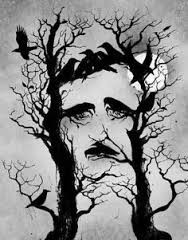
Once upon a midnight dreary, while I pondered, weak and weary,
Over many a quaint and curious volume of forgotten lore—
While I nodded, nearly napping, suddenly there came a tapping,
As of some one gently rapping, rapping at my chamber door.
“’Tis some visitor,” I muttered, “tapping at my chamber door—
Only this and nothing more.”
Ah, distinctly I remember it was in the bleak December;
And each separate dying ember wrought its ghost upon the floor.
Eagerly I wished the morrow;—vainly I had sought to borrow
From my books surcease of sorrow—sorrow for the lost Lenore—
For the rare and radiant maiden whom the angels name Lenore—
Nameless here for evermore.
And the silken, sad, uncertain rustling of each purple curtain
Thrilled me—filled me with fantastic terrors never felt before;
So that now, to still the beating of my heart, I stood repeating
“’Tis some visitor entreating entrance at my chamber door—
Some late visitor entreating entrance at my chamber door;—
This it is and nothing more.”
Presently my soul grew stronger; hesitating then no longer,
“Sir,” said I, “or Madam, truly your forgiveness I implore;
But the fact is I was napping, and so gently you came rapping,
And so faintly you came tapping, tapping at my chamber door,
That I scarce was sure I heard you”—here I opened wide the door;—
Darkness there and nothing more.
Deep into that darkness peering, long I stood there wondering, fearing,
Doubting, dreaming dreams no mortal ever dared to dream before;
But the silence was unbroken, and the stillness gave no token,
And the only word there spoken was the whispered word, “Lenore?”
This I whispered, and an echo murmured back the word, “Lenore!”—
Merely this and nothing more.
Back into the chamber turning, all my soul within me burning,
Soon again I heard a tapping somewhat louder than before.
“Surely,” said I, “surely that is something at my window lattice;
Let me see, then, what thereat is, and this mystery explore—
Let my heart be still a moment and this mystery explore;—
’Tis the wind and nothing more!”
Open here I flung the shutter, when, with many a flirt and flutter,
In there stepped a stately Raven of the saintly days of yore;
Not the least obeisance made he; not a minute stopped or stayed he;
But, with mien of lord or lady, perched above my chamber door—
Perched upon a bust of Pallas just above my chamber door—
Perched, and sat, and nothing more.
Then this ebony bird beguiling my sad fancy into smiling,
By the grave and stern decorum of the countenance it wore,
“Though thy crest be shorn and shaven, thou,” I said, “art sure no craven,
Ghastly grim and ancient Raven wandering from the Nightly shore—
Tell me what thy lordly name is on the Night’s Plutonian shore!”
Quoth the Raven “Nevermore.”
Much I marvelled this ungainly fowl to hear discourse so plainly,
Though its answer little meaning—little relevancy bore;
For we cannot help agreeing that no living human being
Ever yet was blessed with seeing bird above his chamber door—
Bird or beast upon the sculptured bust above his chamber door,
With such name as “Nevermore.”
But the Raven, sitting lonely on the placid bust, spoke only
That one word, as if his soul in that one word he did outpour.
Nothing farther then he uttered—not a feather then he fluttered—
Till I scarcely more than muttered “Other friends have flown before—
On the morrow he will leave me, as my Hopes have flown before.”
Then the bird said “Nevermore.”
Startled at the stillness broken by reply so aptly spoken,
“Doubtless,” said I, “what it utters is its only stock and store
Caught from some unhappy master whom unmerciful Disaster
Followed fast and followed faster till his songs one burden bore—
Till the dirges of his Hope that melancholy burden bore
Of ‘Never—nevermore’.”
But the Raven still beguiling all my fancy into smiling,
Straight I wheeled a cushioned seat in front of bird, and bust and door;
Then, upon the velvet sinking, I betook myself to linking
Fancy unto fancy, thinking what this ominous bird of yore—
What this grim, ungainly, ghastly, gaunt, and ominous bird of yore
Meant in croaking “Nevermore.”
This I sat engaged in guessing, but no syllable expressing
To the fowl whose fiery eyes now burned into my bosom’s core;
This and more I sat divining, with my head at ease reclining
On the cushion’s velvet lining that the lamp-light gloated o’er,
But whose velvet-violet lining with the lamp-light gloating o’er,
She shall press, ah, nevermore!
Then, methought, the air grew denser, perfumed from an unseen censer
Swung by Seraphim whose foot-falls tinkled on the tufted floor.
“Wretch,” I cried, “thy God hath lent thee—by these angels he hath sent thee
Respite—respite and nepenthe from thy memories of Lenore;
Quaff, oh quaff this kind nepenthe and forget this lost Lenore!”
Quoth the Raven “Nevermore.”
“Prophet!” said I, “thing of evil!—prophet still, if bird or devil!—
Whether Tempter sent, or whether tempest tossed thee here ashore,
Desolate yet all undaunted, on this desert land enchanted—
On this home by Horror haunted—tell me truly, I implore—
Is there—is there balm in Gilead?—tell me—tell me, I implore!”
Quoth the Raven “Nevermore.”
“Prophet!” said I, “thing of evil!—prophet still, if bird or devil!
By that Heaven that bends above us—by that God we both adore—
Tell this soul with sorrow laden if, within the distant Aidenn,
It shall clasp a sainted maiden whom the angels name Lenore—
Clasp a rare and radiant maiden whom the angels name Lenore.”
Quoth the Raven “Nevermore.”
“Be that word our sign of parting, bird or fiend!” I shrieked, upstarting—
“Get thee back into the tempest and the Night’s Plutonian shore!
Leave no black plume as a token of that lie thy soul hath spoken!
Leave my loneliness unbroken!—quit the bust above my door!
Take thy beak from out my heart, and take thy form from off my door!”
Quoth the Raven “Nevermore.”
And the Raven, never flitting, still is sitting, still is sitting
On the pálid bust of Pallas just above my chamber door;
And his eyes have all the seeming of a demon’s that is dreaming,
And the lamp-light o’er him streaming throws his shadow on the floor;
And my soul from out that shadow that lies floating on the floor
Shall be lifted—nevermore!