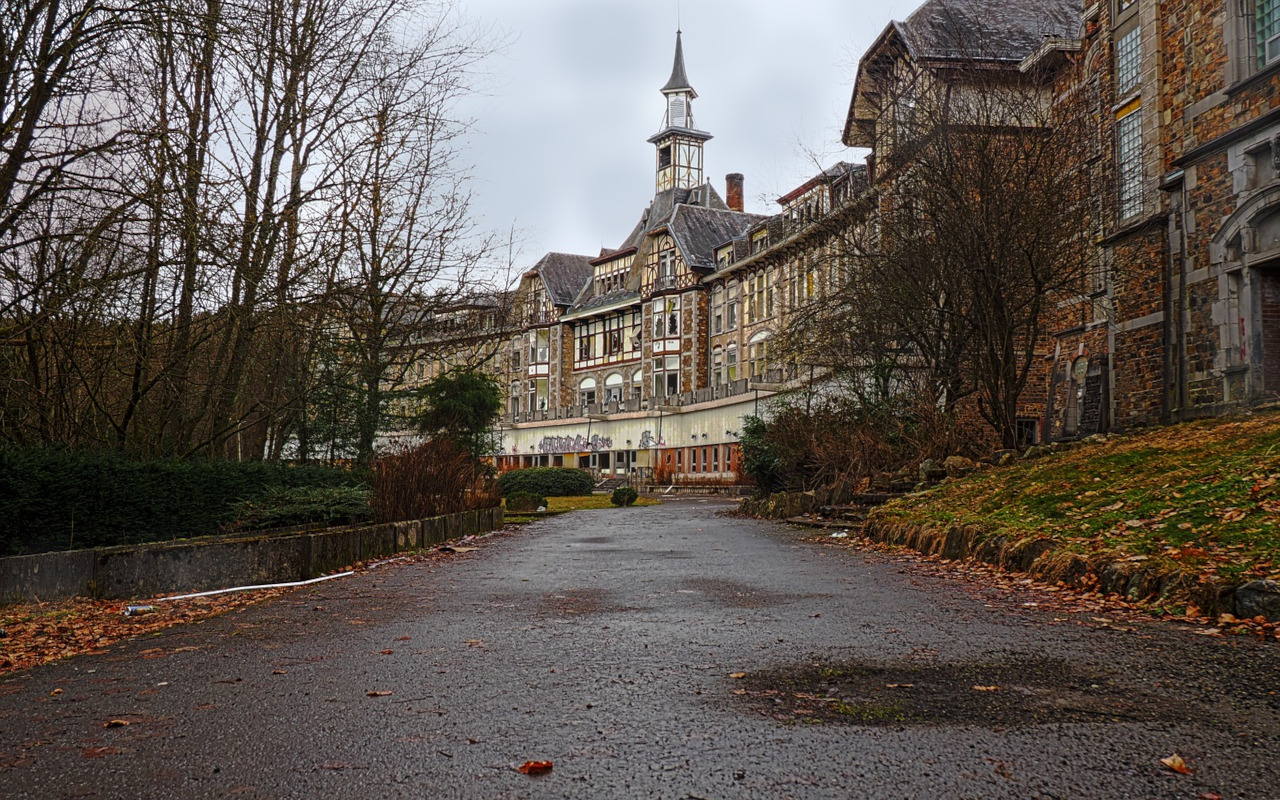
There was something about that old building, with its sheer lines and a facade from another era, that made you not want to be there. Its entrance seemed to warn that if you crossed the threshold, something ill might befall you.
Ah… that door looked like the gaping maws of that monstrous structure, situated on the slopes of the Cordoban Sierra, which bore the name “Hospital de los Morales”: remote, solitary, inhospitable, passing entirely unnoticed in the darkness, huddled and hidden within the grove. Truly, the purpose it had served during the previous century was neither the best nor the most suitable. Too many deaths had occurred in that place, destined then for the dying in the twilight of their lives, so that their final contemplative vision might be peaceful and serene, with that marvelous, open, green landscape. On the other hand… it was sufficiently far from the city.
Certain people, the moment they stepped onto the grounds of that hospital, spoke of feeling a shiver run down their spine, ending in a tingling at the nape of the neck. Others claimed they had the sensation of being watched by someone—or something—perceived only occasionally out of the corner of one’s eye.
—Home, sweet home —I thought.
Currently, its use was different: minor interventions and psychiatry. It was a quiet place. When you looked toward the Sierra through the large windows, you could see the trees, flexible with their branches swayed by the wind—cheerful, upright, brilliant, slender—forming a multicolored landscape in autumn and spring, covered by a languid lawn. Old bird nests occupied some corners and recesses of the facade.
Even so, no one took the slightest pleasure in going there, and not just because it was a hospital, but because it was that hospital. It was an impenetrable night, so black that you could only hear the howling of the wind; you couldn’t see more than an inch past your nose. Its hum danced in gusts through the treetops, crashing against the building from different angles, giving rise to a sinisterly orchestrated sound. Its dismal melody reached deep inside you, softly hammering your mind with its infinite whistling.
I entered. When suddenly I saw her there: alone, nervous. So much so that the coins she held in her hand, ready to place a call as quickly as possible, were slipping through her fingers as if they possessed a life of their own. She was unable to insert them into that tiny slot of the telephone booth. The cafeteria remained closed as well; it was no time for it to be open. That humming of the wind did not help her to stay calm, with the added weight that being in a hospital almost never brought anything good. Her nerves grew increasingly frayed.
When suddenly, that false silence that wrapped everything was shattered by the sound of footsteps. Each time, they seemed to draw closer and closer.
—Uhmmm… this was getting interesting —I thought.
The sound was nearer each time—faster, agile, closer. Her hands trembled incessantly; the urgency to make that call grew with every click. Her temples throbbed to the exhausted rhythm of a heart pushed to its limit.
I drew a little closer, but only enough to better observe the situation. I did not want my curiosity to have any unintended consequences. I was always the invisible spy. And so it had to remain.
A hand rested on her shoulder. She turned and… hissed a sigh of relief.
—Madam, what are you doing here at this hour?
—I had to make a phone call.
She replied contritely but somewhat relieved, upon seeing it was the security guard making his rounds. He escorted her back to the room where her father was admitted, but not before warning her that at this hour, that wing of the building was opened so that the mentally ill could wander. She was taken aback by this comment; she would never have imagined it. She thanked him once they reached the room. She was sad, frightened, and in that instant, she felt alone, even though he was right there beside her, lying in that bed. It wasn’t a major operation that her life depended on—merely an eye surgery—but that lady tremendously hated hospitals.
—Curious —I thought.
I pulled out my journal—dated many years ago—and scanned the surroundings. I decided to follow the security guard, who had returned to drink the warm coffee he had set aside when he heard the strange footsteps, only to find it had already gone cold. He looked through that large window, trying to discern something in the darkness.
I approached carefully so he wouldn’t notice my presence. I looked at that drink that should be consumed hot, steaming, bitter with a fruity or chocolatey touch; a luxury also of the gods. Perhaps just once I could perceive its aroma… —as always, nothing at all—, as on so many other occasions. That man was also affected by the passage of time; sometimes it felt eternal to him.
—My friend, I hope you’ll be kind to me —he said aloud—. When my time comes, of course.
How could it be? Could he perhaps sense my presence out of the corner of his eye?
I checked my journal: he was not in it yet. I touched his coffee, brought my fingers close, and warmed it for him once more. And there I remained silent, as I did so many other nights with him, by his side. We had spent many moments there together, though he could not hear or see me. We were bound by loneliness and, in a way… by watchfully guarding the normalcy of that strange and secluded place.
—Quiet now, my friend, I will be kind —I replied, though he could never hear me.
I stayed there, by his side.