 “Some may say that I couldn’t sing, but no one can say that I didn’t sing.”
The True Story of Florence Foster Jenkins: The Worst Singer in History
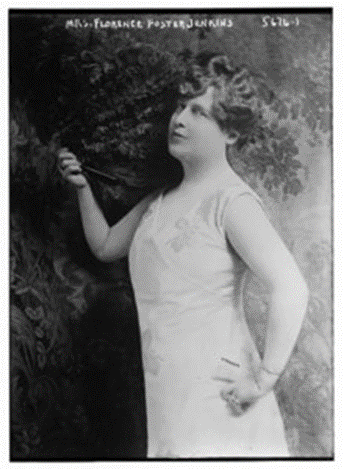
Daughter of a wealthy lawyer, Florence Foster was born in Pennsylvania on July 19, 1868. She grew up as an only child, as her younger sister passed away at a very early age. During her early years, Florence was known as “Little Miss Foster”; she played the piano and even performed a piece at the White House for Rutherford B. Hayes, then President of the United States.
From a very young age, Jenkins received music and singing lessons. It wasn’t long before she expressed to her parents her desire to continue her performance classes with a more professional focus. However, her father, knowing his daughter’s musical “qualities,” refused Florence’s wish and forbade her from continuing her music studies.
When someone is convinced they possess a quality, it’s hard to tell them otherwise. The fact is that Florence Foster Jenkins might have had a future in countless fields, but in music, it would have been not only risky but even reckless to bet on this angel of laughable sound.
Far from abandoning her dream of being a singing star, Florence decided to flee to Philadelphia with the man who would later become her husband (in 1885), the physician Frank Thornton Jenkins. If he didn’t trust the musical future of his young lover, he certainly knew how to disguise the tremendous sound her voice produced when singing.
However, marriage to Dr. Jenkins brought only misery to her life: a few months after getting married, Florence discovered that her husband had infected her with syphilis. The relationship ended, though the marriage was not officially finalized until 1902.
It seemed her destiny was marked by misfortune: in addition to her venereal disease, Florence suffered an arm injury, which prevented her from continuing as a piano teacher—the profession she had used to earn a living during her stay in Philadelphia.
Florence felt an impetuous and enormous desire to devour the stage. It didn’t matter what her parents, her husband, or her friends said. To her, her voice was weak but unique, and sooner or later, if she continued pursuing her dream of being a great opera singer, she would achieve it.
It was upon moving to New York that the myth began to be born. There, Florence decided she wanted to be a singer, and after her father’s death in 1909, she received a large fortune as an inheritance, allowing her dream of singing opera to take shape. While taking singing lessons, she inserted herself into New York’s musical circles and even created her own musical venue: The Verdi Club, an organization entirely dedicated to promoting and disseminating new American talents around the world.
She gave her first recital in 1912 with the consent of St. Clair Bayfield, a British actor who became first her manager and then her husband. Much was said about Bayfield’s supposed homosexuality, leading many to believe it was a marriage of convenience. Regarding her debut as a singer, Florence declared: “The world heard my voice the same year the Titanic sank,” although no connection between the two incidents has ever been proven.
Accompanied by pianist Cosmé McMoon, who couldn’t help but make strange and amusing faces at Jenkins’ off-key notes—which were practically in every phrase she sang—the pianist spent the recital trying to correct the discordant notes with the piano and distracting a laughing audience with his comic expressions. Florence always defended herself against the laughter with the conviction that it came from the foulest and vilest envy of professional colleagues who snuck in among the spectators. She offered the public a spectacle of bizarre and massive proportions: to her absolute lack of rhythm, phrasing, intonation, and non-existent technique, she added extravagant costumes—designed by herself. Notably, although the audience choked with laughter during her presentations, every show ended with applause from all spectators, and she was even compared to figures such as Frieda Hempel or Luisa Tetrazzini.
Gradually, as the months and World War I passed, Florence continued her work organizing benefit performances and raising funds for them. Since Jenkins herself organized the galas, she included herself on the bill, considering she had every right to do so. What initially consisted of a few charity galas where she practically paid to participate was becoming a musical phenomenon that would revolutionize the conception of Opera—or rather, of Opera singers—at the beginning of the last century. Over the years, Florence found her place in Manhattan. In a way, the people who knew her didn’t try to question her musical qualities. Florence was more than sure of her talent, and in the face of that obsession, reason became an element of secondary importance. The truth is that Florence gave recitals at the Ritz-Carlton Hotel and “interpreted” opera arias whose execution required overcoming abysmal difficulty.
In 1928, Florence had to face the death of her mother, her only surviving relative. This news, instead of diminishing her desire to continue her difficult career, gave her the freedom she had always wanted. From this moment on, her life would revolve by and for Opera.
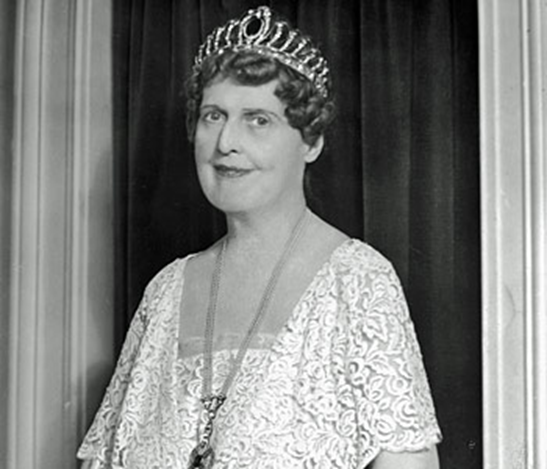
The fact that Jenkins only offered private recitals made her figure something enormously desired. Even if someone possessed a ticket for one of her recitals, no one occupied a seat in the theater without her personal approval. The first to fall at her feet were Manhattan’s high bourgeoisie, although great musicians like Enrico Caruso never missed the big event of the arrhythmic diva. In addition to being a private concert, Florence demanded that each spectator stop by her suite at the Hotel Seymour before the recital. Once there, Jenkins herself warned that her tickets were only for people who truly loved music. If you passed the test of obtaining a ticket and subsequently Jenkins’ approval, a good time of fun and laughter was guaranteed—the habitual sound of Florence’s audience.
In 1943, Florence suffered a terrible accident in the taxi she was traveling in. Her audience and she herself feared she would never sing on stage again. While recovering and returning to singing exercises, she realized that her voice could reach an even higher pitch. Far from suing the taxi driver, Florence presented him with a box of Havana cigars.
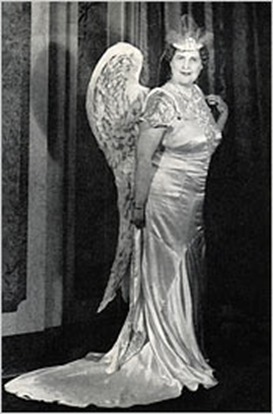
In her annual recital at the Ritz Carlton, her character, dressed in white and with angel wings on her back, managed to conquer New York from Brooklyn to Manhattan. It was the most anticipated annual musical event, attended by 800 guests, and requiring police intervention to maintain order. Thousands of people crowded the doors of the Ritz, while some took advantage of resale, getting up to ten or twenty dollars for each ticket when Jenkins herself sold them for two and a half dollars. It was a phenomenon in all its glory.
After years and years of popular demand, at age 76, on October 25, 1944, she fulfilled the dream of her life: performing at Carnegie Hall in New York. For that great day, Florence prepared an impressive repertoire. She knew she could win everyone over and set no limits when choosing what to sing. She began by singing the Bell Song, and critics hissed and shouted all sorts of insults. Only the laughter of the other attendees could silence the “delights” the experts howled at her.
After performing the Bell Song and Carmen, Florence, clad in her white-winged costume, sang the song Clavelitos, a moment when the audience’s laughter made it impossible to distinguish between Florence’s voice and those of the women in attendance.
Tickets sold out immediately, and for the first time, critics attended who had never seen her sing live. The critical consensus was disastrous, massacring her in the newspapers the following day.
Just one week later, at age 76, Florence passed away in her suite at the Hotel Seymour in Manhattan. Legend holds that although the audience bid her farewell with applause and cheers, Florence couldn’t bear the bad reviews of her performance at Carnegie Hall, and this affected her so much that it ultimately caused her death just one week after stepping onto the stage of New York’s most prestigious theater.
The truth is that the real cause of her death was syphilis: at that time, it was believed that the disease should be fought by ingesting mercury and arsenic, which ultimately worsened the medical condition. Penicillin treatment would not be discovered until years later.
Florence Foster Jenkins died alone. Having no descendants or relatives, the board of The Verdi Club was the sole beneficiary of Jenkins’ inheritance. Despite not traveling the world from theater to theater, she recorded and edited several records.
Even with her lack of singing talent, Florence managed to fill every venue where she appeared and enjoyed the audience’s favor. Although spectators laughed, they genuinely enjoyed Florence’s performance. Perhaps this was because in each of her performances, she transmitted enthusiasm and true love for music:
“Some may say that I couldn’t sing, but no one can say that I didn’t sing.”
The World-Telegram newspaper published the following obituary after her death: ‘She was extremely happy in her work. It is a pity that so few artists are. The joy was transmitted as if by magic to those who heard her.‘
Discography
Jenkins recorded nine arias on five 78-rpm records, which were later reorganized into three CDs.
- The Muse Surmounted: Florence Foster Jenkins and Eleven of Her Rivals (Homophone Records): contains only one of Jenkins’ performances, “Valse Caressante,” for voice, flute, and piano, but includes an interview with the composer and her accompanist, Cosmé McMoon.
- The Glory of the Human Voice (RCA Victor): contains the other 8 arias, all accompanied by McMoon.
- Murder on the High C’s (Naxos): contains her 9 arias plus performances by others, but lacks the interview with McMoon.
Historical Video of Florence Foster Jenkins
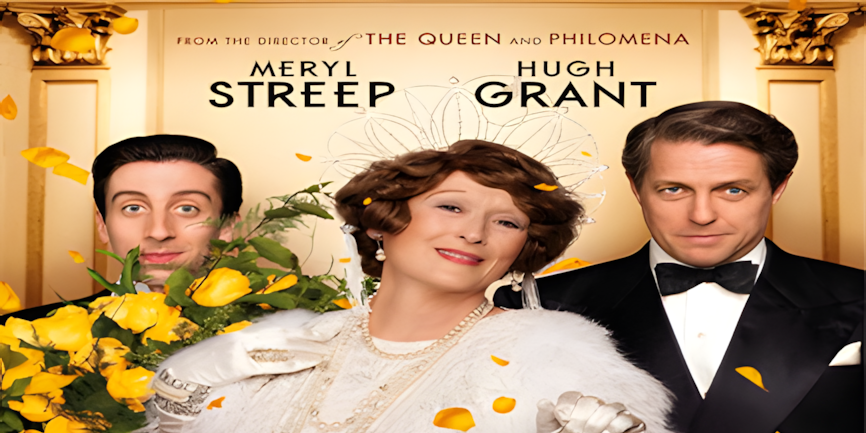
Film Based on Her Life
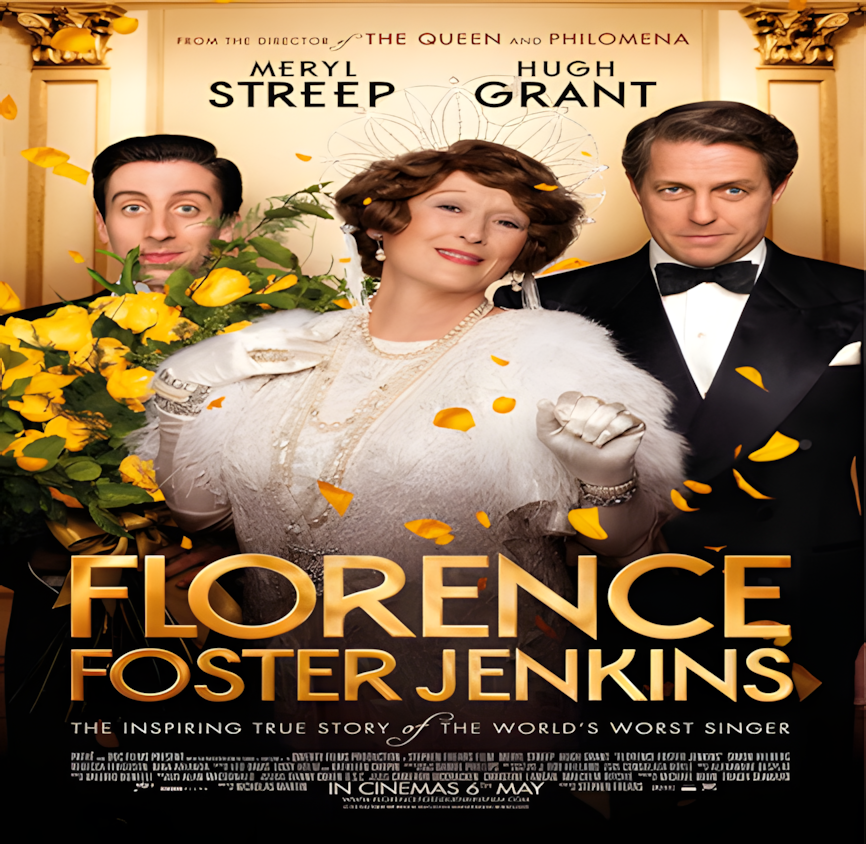
- Original Title: Florence Foster Jenkins
- Year: 2016
- Duration: 110 min.
- Country: United Kingdom
- Direction: Stephen Frears
- Screenplay: Nicholas Martin
- Music: Alexandre Desplat
- Photography: Danny Cohen
- Cast: Meryl Streep, Hugh Grant, Simon Helberg, Nina Arianda, Rebecca Ferguson, Neve Gachev, Dilyana Bouklieva, John Kavanagh, Jorge Leon Martinez, Danny Mahoney, Paola Dionisotti, David Menkin, Philip Rosch, Sid Phoenix
- Production: Qwerty Films, Pathé, BBC Films, Pathé Pictures International
- Genre: Comedy. Drama | Biographical. Opera
Synopsis: Tells the true story of Florence Foster Jenkins, a woman who, upon inheriting her father’s fortune, was able to fulfill her dream of studying to be a soprano. The problem was that she lacked talent, but people flocked to her recitals to see for themselves if she was truly as bad a singer as the critics said. (FILMAFFINITY)
Awards:
- 2016 Oscar Awards: Nominated for Best Actress (Meryl Streep) and Costume Design.
- 2016 Golden Globes: Nominated for Best Motion Picture – Comedy, Actor, Actress, and Supporting Actor.
- 2016 David di Donatello Awards: Nominated for Best European Film.
- 2016 BAFTA Awards: Best Makeup and Hair. 4 nominations.
- 2016 Critics Choice Awards: Best Actress in a Comedy (Meryl Streep). 3 nominations.
- 2016 European Film Awards: Nominated for Best Actor (Grant).
- 2016 Satellite Awards: 2 nominations including Best Actress (Meryl Streep).
- 2016 Screen Actors Guild (SAG) Awards: Nominated for Best Actress (Streep) and Supporting Actor (Grant).
Reviews:
- “‘Florence Foster Jenkins’ is built on a great casting coup, associating excellence (Streep) with its opposite (Jenkins) (…) Hugh Grant brings a very complex and nuanced pathos to his embodiment of St Clair Bayfield” — Javier Ocaña: Diario El País
- “The story is small and its main appeal resides in the strength of its performers (…) It is not among Stephen Frears’ best but results in stimulating entertainment (…) Score: ★★★ (out of 5)” — Alberto Bermejo: Diario El Mundo
- “Frears adopts a sentimental and vocationally light approach that avoids thorny issues and critical reflections. (…) the priority is to celebrate those with the courage necessary to pursue their dreams (…) Score: ★★★ (out of 5)” — Nando Salvá: Diario El Periódico
- “You have to be Stephen Frears to tell such a comic true story without ruining it with the typical cocktail of ego and pretensions (…) Score: ★★★ (out of 5)” — Federico Marín Bellón: Diario ABC
- “‘Florence Foster Jenkins’ is a modest and pleasant film, but in the end it seems smaller than its subject, a very conventional portrait of a very unconventional woman.” — Stephen Dalton: The Hollywood Reporter