Chapter 1: The Discovery
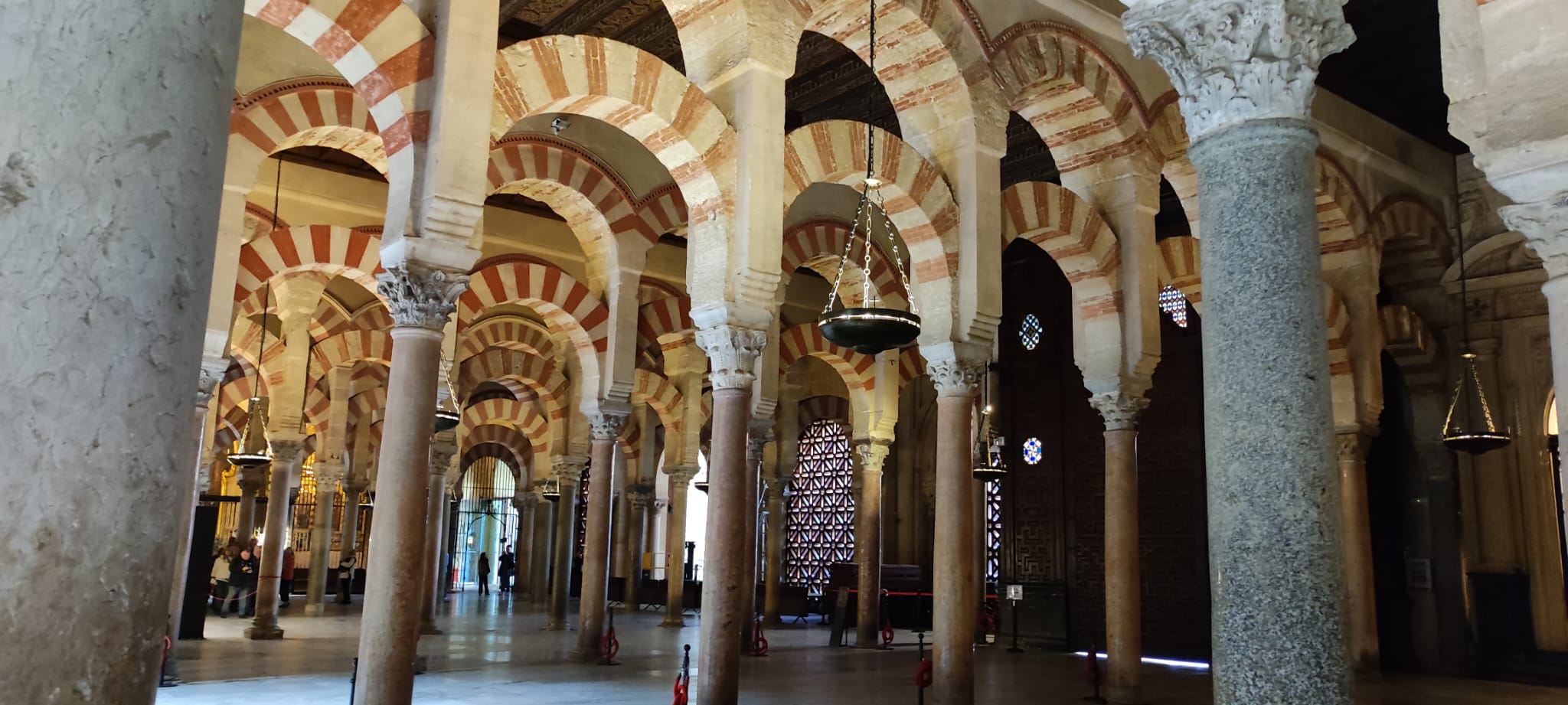
Pedro, the security guard at the Holy Cathedral Church of Córdoba—popularly known as the Mosque—could not believe his eyes. The sun was barely peeking over the horizon when he found the body floating face down in the fountain of the Courtyard of the Orange Trees (Patio de los Naranjos). It was a monk, dressed in a tattered tunic, with a gaunt face. Pedro had not left his post, except for a quick trip to the restroom. How could something like this have happened? Normally, the nights were peaceful; the sky was clear, and the moon illuminated the courtyard along with the small lanterns scattered around. Nothing extraordinary ever happened. Although the job carried great responsibility due to the historical importance of the site and the treasures kept within, it was generally quiet—until that fateful night. How could it have happened? He was going to “lose his hair” over this, as they say, if he hadn’t already lost it all. He ran a hand over his bald head as he reconsidered the events. He would swear on the Bible and before anyone that he hadn’t moved except to use the restroom. How long could it have taken? Five minutes at most. Someone would have had to be very fast and agile. Moreover, another question loomed: where had they entered?
“Focus, Pedro. First thing: notify the center and call the police immediately,” he told himself.
And so he did. After making the calls, he moved closer to look at the floating corpse. He looked like a monk. Pedro didn’t touch him even slightly; he didn’t want to contaminate the crime scene.
He decided to inspect every single door. They were all locked tight. He wasn’t a policeman, but he knew this would be very difficult to solve. It was a mess for him and for whichever inspector took the case.
“Well, that’s not your problem. Your problem is getting out of this situation innocent and unscathed.”
He felt disgusted, his pride wounded, worried, and disappointed in himself.
Chapter 2: The Call
Homicide Inspector Rafael received the grim call in the early hours of the morning. He was sleeping on white sheets with the air conditioning on; the nights were unbearable due to the heat.
He couldn’t quite believe what he was hearing on the other end of the line.
“Rafael, they’ve found a body in the Courtyard of the Orange Trees. It’s your turn; shift change.”
“In the Courtyard of the Orange Trees! Are you sure?” he asked while rubbing his eyes.
“As you heard. Go straight there.”
Rafael dressed and performed his morning ablutions, but not before having a black coffee prepared in his Neapolitan pot. As he drove there, he thought about the repercussions this would have for the city of Córdoba and, looking at it selfishly, for himself. He was certain he would face pressure from the commissioner, who in turn would be pressured by the Cathedral Chapter of Córdoba to solve the case as quickly as possible and close the file. The Mosque was a sacred, protected place, equally important to believers and non-believers alike—an intercultural meeting point, even if lately there seemed to be a growing trend of downplaying its Al-Andalus heritage. A murder would affect tourism and the community.
As he approached the cordoned-off area, guarded by both National and Local Police, he mentally prepared himself for the worst—and it wasn’t just because of the strange setting of the crime.
The first thing he did upon arrival was seek out the security guard and hold an intimate conversation with him, alone, without interruptions. It wasn’t an interrogation per se; it was a friendly and curious conversation.
This was a complicated enigma.
After talking, they both concluded it was hard to tell how anyone had managed to enter and exit. Until the inspector noticed the ancient passages that had been under study and cataloging. As they headed to the site, Rafael was stopped ipso facto by his colleagues from the forensics team to show him a piece of parchment the monk was clutching in his right hand. The fountain’s water spouts had been turned off, and the silence was only broken by their own noise and the first songs of the birds, including the blackbirds.
“Is it a parchment?” he asked in astonishment as he took it carefully with gloved hands.
Pedro looked over the inspector’s shoulder, equally surprised.
“I promise you I hadn’t noticed he had anything in his hands,” he responded, excusing himself.
Everything seemed to be getting more and more tangled.
Chapter 3: The Father and the Contacts
Three hours had passed since Rafael arrived at the Mosque. The judge had arrived quickly; he could not afford to be even a minute late in such an extraordinary case. He authorized the removal of the body, and after the preliminary on-site report by the forensic doctor, the body was transferred to the Forensic Anatomic-Pathological Institute of Córdoba.
Rafael received a call from his father, Carlos, an influential lawyer with a prestigious firm. Though strict, he loved his son and was always ready to help him.
“I’ve just heard the news.”
“News flies faster than a hawk. Who told you?”
“The bishop.”
“Father, I don’t have time for formalities or to flatter anyone.”
“Rafael! I didn’t raise you to speak to me that way.”
Rafael took a deep breath before responding to his father.
“Sorry. You’re right. Why did he call you?”
“To get information. He found out you’re my son. Let’s just say I have professional commitments with the bishopric.”
“I see.”
“Don’t be condescending. Do you know anything?”
Rafael didn’t intend to give him more information than what was being given to the press. At least not for now.
“We’ve barely had time to investigate. A body in monk’s clothing was found in the fountain, floating face down.”
Rafael decided to withhold the information about the parchment.
“By the way, there are already ecclesiastical representatives here. So to speak.”
“You aren’t giving me much information, I must say.”
“Father, you know I can’t tell you more for now.”
Carlos surprised his son with the next question.
“And the parchment?”
“How do you know about the parchment!?”
Rafael looked around and noted the number of people there who were neither police nor forensics. He also counted the number of security cameras. He looked for Pedro, who was still standing under one of the orange trees.
“Father, I have to hang up. I’m being requested,” Rafael asserted.
“Very well, son. I understand. Take heart; count on me if you need me.”
Rafael suspected he would need his help and his contacts to solve the case or at least to ease the pressure on his shoulders.
Together they investigated the monk’s background. He didn’t belong to any known order. What secret was he hiding? Why had he been killed in the Mosque?
Chapter 4: The Mystery
The monk had no identification. Who was he really? What was he seeking in the Mosque? And why had someone killed him? The enigma deepened, and Rafael knew he had to discover the truth before the shadow of the mystery covered the entire city.
Rafael already knew how he had managed to access the courtyard, and it had become crystal clear to him that it was someone with very important contacts and access to all the documentation of the archaeological studies recently carried out in the Mosque. It was a hired killer, sent to prevent the monk from going further than intended. Therefore, there was a probability that the order had been given by someone from the same brotherhood or someone close to it.
However, over the course of the investigation, no satisfactory answer was obtained regarding which order he belonged to. He remained almost as he had at the beginning.
The security cameras lost their connection for ten minutes—the crucial time to commit the murder and leave the site. This meant that while Pedro was discovering the body, the killer was fleeing through the passages, but had left behind the parchment the corpse was holding. Most likely, he had to flee before being discovered by Pedro, who was returning to his initial position. It also meant that the killer had to be someone of slight build and in good shape to fit through the narrow passage.
Chapter 5: The Clues
When Rafael examined the monk’s body, there were no signs of a struggle, but his expression reflected terror. The ancient parchment he clutched tightly in his right hand had inscriptions drawn in Arabic, according to his colleagues from the forensics team. What secret did that manuscript hold?
Chapter 6: The Parchment
The parchment revealed geographic coordinates and an enigmatic message: “The path to the truth is hidden within the sacred verses.” Rafael immersed himself in the research. Verses from the Quran, legends of Al-Andalus, and the mysteries of the Mosque became intertwined.
He still hadn’t found the culprit; nonetheless, he knew he was getting closer to the truth. Each step made him and his family more vulnerable to danger.
“Father, I need you all to be careful. We don’t know who is behind this, but it is a very powerful organization. Be careful—you and Mother.”
Chapter 7: The Plot
Carlos, Rafael’s father, decided to help his son indirectly. Certain high-ranking Church officials owed him favors, and now was the time to collect them. He asked for permission to visit the bishopric’s library and gain access to certain documents not available to non-clergy. He discovered connections between the monk and a secret society belonging to the Church, believed to have been extinct for over two hundred years.
He cautiously took photographs with his mobile phone to avoid being caught and sent them to his son before leaving; he didn’t want to risk losing them. As he headed toward the exit, he was intercepted by one of the priests, who politely but firmly demanded his phone. Carlos claimed his right not to hand over his phone or anything of his, since the priest had no authority to seize it.
“I have the authority of God. Do you know of a greater authority?” the priest asked ironically. “You are in His house.”
“I must tell you that His house is the church, and furthermore, God is everywhere.”
“If you wish, we can continue with these dialectical games. I have all the time in the world. But you are not leaving here with that phone without it being checked.”
Carlos yielded to the threat and deleted the recently taken photos. He left like a soul possessed by the devil, his heart racing as if it were about to burst from his chest, the tension throbbing in his temples, his eyes glazed with fear and anger for what had just happened. He was used to the law and the courts, not this kind of confrontation.
The photos had been received and opened by his son, who had already been alerted by his father.
Apparently, they were searching for an ancestral treasure that could change history. The Chapter of Córdoba was more restless than usual; it was beginning to move pieces on the chessboard of hierarchical power. Coincidence or not, the Pope was going to make a visit to Madrid—a visit that was not publicly announced and about which Rafael had been informed by the Madrid headquarters.
Chapter 8: The Revelation
Carlos performed his role as a lawyer and utilized his excellent social connections well to protect his son and allow him to work with a bit more freedom. Rafael sought an external advisor, an expert in the history of Córdoba, and turned to María Dolores Baena. Following the clues left behind, and after conducting the corresponding studies, they found a hidden crypt beneath the Mosque. There, they found ancient symbols with significant meaning and an altar that hadn’t seen the light of day for far too long. The treasure was close, but so was death. The enigma was getting closer and closer, so much so that it seemed palpable. The advisor was wide-eyed and open-mouthed at such a discovery. It was a dream come true for someone who loved history.
Chapter 9: The Outcome
After examining all the inscriptions, the treasures, the altar, and the ancient written language, Rafael was finally able to unravel the enigma. The monk belonged to a secret order that protected the treasure with their very lives—and so it had happened. The Chapter was aware of the existence of said order, but they had to keep silent and prevent others from finding the place, because the message encrypted in that ancient language would change the meaning of the Christian religion and, no less importantly, reveal secrets that could change the history of Córdoba as we know it. Rafael faced his greatest challenge: saving the truth and his own life.
And so, in the dark underground passages of the Mosque, a new chapter was written in the history of the city.