The expression clase magistral is the Spanish alternative to master class.
As the Oxford dictionary indicates, the English term master class, used to refer to a lesson, workshop, or seminar led by experts in a particular area or subject, can be translated into Spanish as clase magistral.
The master class offered by best-selling author Dolores Redondo began with a delay of more than thirty minutes, which is understandable given the frenetic pace of her participation in Córdoblack. This was the first edition of the event and, much as it pains me to say, I must admit that there is still a great deal of room for improvement regarding its organization. Nevertheless, they have finally taken the initiative to hold such an event in a city like Córdoba—a city that lends itself so perfectly to legends, tales, romances, histories, and crime fiction.
To gain access to the event, one had to submit a text of about ten lines. I could think of nothing better than the opening of the Huérfilo chapter from my own crime novel, “Tip-Tap, They Stalk You in the Dark”, which reads as follows:
During the journey to the Forensic Pathological Institute, Alonso López Sanjuan seemed not to be there. And, in a way, he wasn’t. His daughter—the thing he loved most in this world—was no longer in it, this world that now seemed to have turned into a nightmare. He would never again see her beautiful smile, nor her pearly teeth, her beautiful, bright eyes. He would never again feel those warm hugs of a daughter who had not yet become a mother. It felt as if it were all a bad dream, as if this were not the true reality; he was merely letting it pass, being a simple spectator, not interacting. He was being dragged toward the true reality, to the edge of the precipice of that bad dream. He did not want to wake up….
No introduction was necessary to recognize such a great writer; she was received with enthusiastic applause. I suspect she may not be aware of how difficult it is to earn applause from a Cordovan audience. Having attended many great plays, operas, and zarzuelas here, I can attest to our high standards; we are not a people who give away cheers and applause lightly.
Well, after the customary applause, the author began by explaining that she was there to resolve any literary doubts we might have. Each person who asked a question did so by raising their hand, introducing themselves, and then posing their question with a mix of respect, hope, and trepidation.
I must say that, in my view, the questions were rather basic and well-worn; none left the comfort zone. Perhaps this thought stems from the fact that I have written three works—two published and one awaiting a response from a publisher. Maybe if I had found myself in this same situation when I was still a novice writer, I would have asked the same questions.
What were they? I will summarize her answers here; please note this is not an exact transcription of her words.
—Q: How does the story come to you?
—A: I transcribe it bit by bit; I take ideas, and what I always do is write the work by hand because it helps me connect better.
—Q: What do you do when you hit a block?
—A: I have never really had a “block” as such, perhaps because I don’t sit down to write until I have documented enough and have the story well-formed in my mind. When I have had small sticking points, usually in dialogues, I take a bath or go out with my pet—any activity that helps me disconnect.
—Q: How do you get into the mind of a killer or a psychopath?
—A: I never enter the mind of a psychopath, nor do I intend to understand them; I refuse to do so. What I do is document myself thoroughly—reading files—and you truly feel dirty when you finish documenting. I will always be on the side of the victim.
—Q: How do you manage to contact a literary agent?
Briefly, I must say that she gave immense importance to the role of the literary agent—something with which I totally agree—but she did not give a clear and objective answer on how to obtain a proper response from one. She spoke of everything she had achieved through her agent: how her books were being made into films and that her latest published book, “The North Face of the Heart,” will soon be seen on television screens as a series. Likewise, she told us that she had reached readers in forty countries and has been translated into forty-three languages.
However, at no point did she mention how she had initially achieved this, nor did she mention that her literary agency is the Pontas Agency.
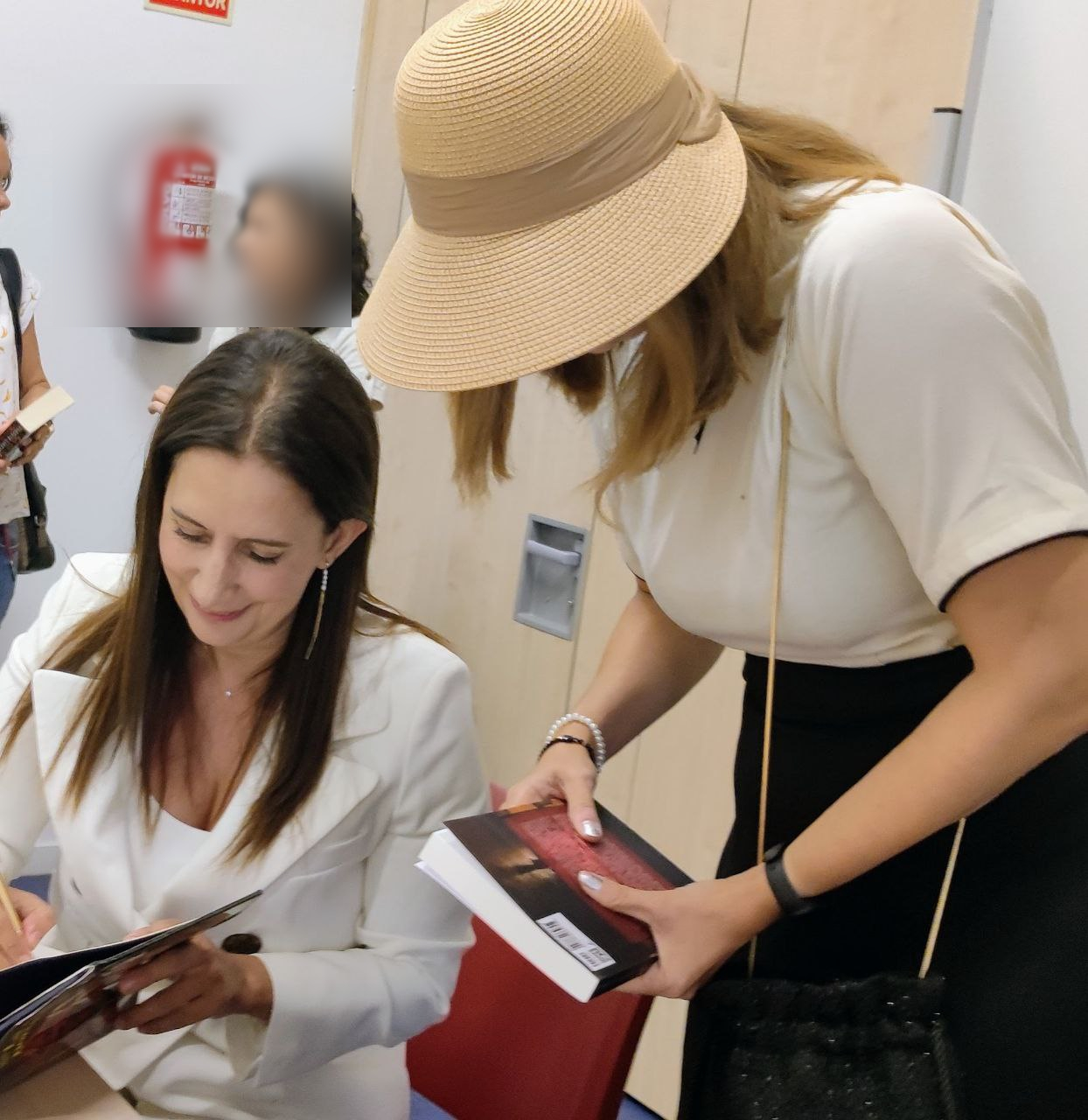
The master class ended with the signing of her books, and I humbly presented her with my latest published book, “Tip-Tap, They Stalk You in the Dark”. I have given her not just a book, but a year’s work, effort, and hope. I hope she knows how to value it and that it doesn’t end up gathering dust in some corner of her library.
It is very well documented with the help of the National Police; they advised me since they are the ones with the experience in solving crimes, not forgetting all the steps and procedures they must perform to obtain and prove the killer’s guilt, as well as capturing them. It is set in Córdoba, featuring the different strata of Cordovan society and naming emblematic areas of the city, as well as a social club of great importance.
Even though I (Lola de la Cámara) am not as professionally well-known as Dolores Redondo, today I am deeply grateful to my readers for the trust placed in me, because without you, I am nothing.
In short, I am doing well; however, it is practically impossible to reach a major publisher. I leave this experience with a bittersweet taste, still waiting for a response from a literary agency.