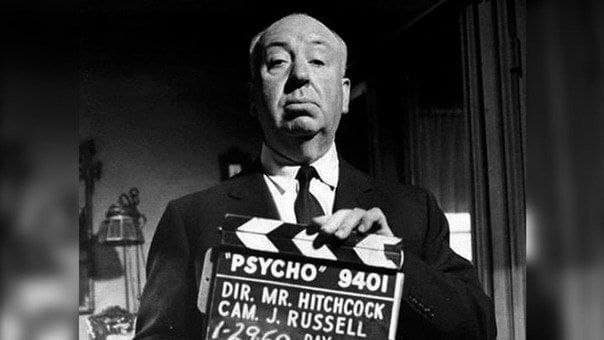
«There are directors whose films are slices of life, but my films are slices of Cake.»
Family Background
Alfred Joseph Hitchcock was born on August 13, 1899, in an apartment located above his parents’ shop at 517 High Road, Leytonstone, in northeast London (a predominantly Catholic neighborhood). He was the youngest of three children born to William Hitchcock and Emma Jane Whelan: William Jr. —born in 1890—, Ellen Kathleen, known as «Nellie» —born two years later—, and Alfred. His parents were of Irish descent and both were raised in the Catholic faith. Regarding this, the filmmaker stated years later that he had «a strict Catholic upbringing […] I don’t think I can be labeled as a Catholic artist, but it is possible that childhood education influences a man’s life and guides his instinct.» In Hitchcock/Truffaut by the French director François Truffaut, Hitchcock describes himself as a «well-behaved boy» whom his father used to call a «lamb without a spot,» and a «loner» who lacked playmates. An anecdote he frequently told was of an occasion when, at the age of five, William sent him to the police station with a letter for the police chief who, upon reading it, locked him in a cell and five or ten minutes later let him go with the warning that this «is what is done to bad little boys.» This event reportedly made him fear the police for the rest of his life.
One of his father’s main tasks was the preparation of orders, and Alfred accompanied the clerk who delivered them. By the age of eight, he had already traversed train stations and bus depots while deliveries were made (he was fascinated by the world of transportation).
In his old neighborhood, mosaics dedicated to the figure and work of director Alfred have been placed at the underground station.
He was always a solitary child, self-conscious about his body weight; something that also markedly affected him was his relationship with his mother, which is manifested in his films. There are four characteristics that marked his life and his maternal emotional dependence:
- His mother had a nightly ritual: she would call him to the kitchen, he would stand by her side, and he would tell her everything he had done throughout the day.
- His mother forced him to accompany his older sister to dances.
- Insistence on Catholic rites.
- He always spent his summers with his mother, even after he was married.
He possessed a great imagination but also a scientific and technical mind, which is clearly seen in his films.
It was in 1920 when Alfred Hitchcock landed his first job in the film industry. His task consisted of designing the titles for silent films at Famous Players-Lasky.
From then on, roles as an editor, screenwriter, and assistant director followed. His first opportunity as a director came with the film Number 13, though its production was never completed.
By the year 1924, several countries were very advanced in the cinematic world, notably the USA and Germany. Different shots were used to emphasize emotions, and Hitchcock systematized every frame for his filmography.
In his early days, he also worked in the film world as an illustrator for silent films, creating illustrated billboards. This was a process of observation and learning for him. Standing out as a great master of editing, he began to take an interest in this aspect when he met his wife Alma, who was an editor and script supervisor.
The beginning of The 39 Steps takes place in a theater. He always went to the theater with his family, which embarrassed him due to the enormous noise they made, and this is reflected in the film. The distance from his family was also evident in their way of speaking (they used a lower-class, unrefined English).
He worked hard on his accent, standing out for his tremendous politeness, and even while living in the USA, he tried to blend both languages.
The British Period
· Blackmail (1929) tells us about Alice, a blonde virgin who cheats on her boyfriend by going out with a painter. When the painter tries to seduce her, she kills him with a knife and returns home in shock. It exists both as a silent film and with sound; the command version had the lead actress dubbed because she didn’t speak English. It represented a transition between silent and sound cinema.
· Young and Innocent (1937): Robert Tisdall finds the lifeless body of a young woman on the beach. He runs for help, but two girls see him and, believing he is the killer, report him to the police. Robert is forced to flee, despite his innocence. In his desperate attempt to prove he is not guilty, he only has the help of one girl. It shows suspense through a clock and the female telephone operator, who acts as a third party.
· The Lodger: A Story of the London Fog (1927): This is his first true suspense film, starting with a very innovative shot that screams at the camera. A serial killer terrorizes the city of London, killing blonde women under the pseudonym ‘The Avenger.’ A mysterious man goes to the boarding house of Mr. and Mrs. Bunting, where he decides to stay. The couple’s daughter is a model who is engaged to the detective handling the murder case. Furthermore, she herself fits the characteristics of the women the killer seeks. Suspicion soon begins to grow that the man living there might be responsible. In a fit of jealousy while trying to flirt with her, the detective accuses the man. Hitchcock appears for the first time in a cameo, seated with his back to the camera. The director begins to define images without a single sound or word; he is the only one doing this in all of England. His technical mastery is overwhelming, but narratively he is not far behind (he has his own cinematic literary style).
The final part is made with models, featuring a constant play of light and shadow.
· In The Pleasure Garden (1925), the foundations of silent films stand out tremendously compared to other British films of the time, even though it was a sound production. Patsy is a chorus girl working for the theater company “The Pleasure Garden.” One day she meets a young newcomer to the city, Jill, who wishes to find a place in the company. Patsy becomes friends with her and gets her an audition, and Jill immediately becomes the star of the show. Jill is engaged to Hugh, a young soldier who must soon part from her to travel to the Tropics, where he is to join the British colony. While Hugh is at his post and Patsy enters into a relationship with Levett, a comrade of Hugh’s, Jill’s fame skyrockets and she begins to seek the company of other men.
· The Man Who Knew Too Much (1934): Bob and Jill Lawrence are a married couple on holiday in Switzerland with their daughter Betty. There they strike up a friendship with Louis Bernard, a Frenchman who is shot in the heart while dancing with Jill. Just before dying, Louis asks Bob to hand over some documents hidden in his room to the authorities. Bob discovers that Bernard was actually a British spy tracking a mysterious organization planning to assassinate a foreign politician in London. Bob then receives a call from a stranger demanding he drop the matter, or his daughter will suffer the consequences. This film, along with two others from his American period (Psycho and North by Northwest), is full of silent film qualities (if we remove the sound, we can see that the shots advance among themselves, giving their own meaning).
· The 39 Steps (1935), based on the adventure novel The Thirty-Nine Steps by John Buchan. Starring Robert Donat, Madeleine Carroll, Lucie Mannheim, Godfrey Tearle, Peggy Ashcroft, John Laurie, and Wylie Watson. It would be the first film where he would have very well-known actors. Full of movement, giving the viewer no time to think. It begins and ends in a theater.
· Sabotage (1936) is based on the novel titled The Secret Agent (a loose adaptation of Joseph Conrad’s novel). In London, in the years leading up to the war, a mysterious woman begins to suspect that her husband, owner of a small neighborhood cinema, is unfaithful to her. When a case of sabotage leaves the city without electricity, the woman realizes it’s not a matter of illicit affairs. His characters are consistent in how they are defined. in this film, a child dies from a bomb without knowing he is carrying it, but the viewers do know. He regretted being the first director to kill a child on screen. It is a great exercise in suspense, providing information to the viewer, which makes the moment unbearable for the audience as it manages to dilate the anguish.
· Secret Agent (1936) takes place before the Second World War. A secret agent is sent to Switzerland to eliminate a spy whose physical features are unknown to him. The place where it happens is important, making it a protagonist in its own right. It is a breeding ground for the social moment.
· Young and Innocent (1937), same screenwriter as The 39 Steps. It is a suspense film with elements of intrigue, romance, and drama. Released in 1937. Although not considered among his best films, the famous director’s style can be appreciated, and it contains some characteristic aspects of his cinema, such as the wrongly accused man. The audience has the information before the protagonists; the long takes dictate the tempo of the film.
· The Lady Vanishes (1938): his first film of international fame. A young socialite tourist, Iris Henderson, travels by train through a Central European country before returning to England, where a wedding she is not happy about awaits her. Because an avalanche has blocked the tracks, passengers are forced to stay overnight in a small hotel. During the night, nearby the establishment, a murder occurs that goes unnoticed by the travelers. The train resumes its journey, and in one of its carriages, Iris strikes up a conversation with an elderly governess, Miss Froy. At one point, the young woman realizes the lady has disappeared and tries to find her. To her surprise, instead of help from the other passengers, Henderson meets with general disbelief; according to her fellow travelers, Miss Froy never existed and is a product of her imagination. The great number of highly detailed model trains stands out. It is full of typical Hitchcockian characteristics.
· Jamaica Inn (1939), the last film of this period. A bizarre film, Hitchcock manages to introduce his vision of the world through both the intrepid woman and the perfect, sometimes comical and always terrible villain, Charles Laughton.